Report | Intelligent Investment
Billions in Transit: Assessing the Impact of Transit Oriented Development on Indian Cities
September 2, 2025 20 Minute Read
Looking for a PDF of this content?
India’s rapid urbanisation, marked by urban sprawl, extended commutes, and housing shortages, is strengthening the case for adopting a strategic and integrated approach to urban planning. While the country has made substantial investments to introduce and expand high-capacity transportation systems, implementing Transit Oriented Development (TOD) at a policy level is paramount for integrating infrastructure with real estate development.
Furthermore, the inherent Environmental, Social, and Governance (ESG) benefits of TOD will play a critical role in shaping a sustainable, resilient, and economically vibrant urban future.
India’s Urban Imperative
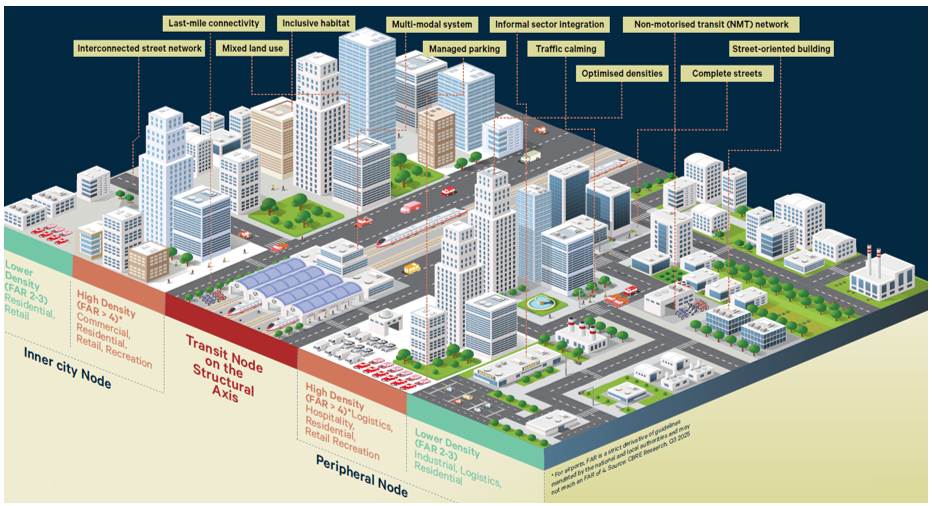
At its core, TOD combines planning and financing strategies to prioritise public mobility and walkability as primary modes of transport. It encourages development of mixed-use projects, multi-nodal hubs, and sustainable cities, leading to vibrant, mixed-use communities centred around transit hubs.
In this report, CBRE Research examines how the TOD model can unlock ~106 million sq. ft. of development / redevelopment potential within transportation nodes across India’s top eight cities.
Why TOD is a Favourable Route for Real Estate Stakeholders
· Incentivises developers to densify projects
· Enhances real estate potential around transit hubs
· Unlocks inner city areas for redevelopment
· Preserves open spaces for enhanced pedestrian experience
· Encourages mixed-use development with pedestrian mobility
The TOD Nodal Structure
Unlocking Opportunities Across Sectors Through TOD
Office:
· Potentially higher rentals / greater long-term value
· Fostering flexible workspaces / specialised formats
· Expedited planning approvals / favourable zoning regulations
Logistics:
· Improved last-mile connectivity
· Potentially increased demand / higher rentals
· Reducing operational costs
Retail:
· Capitalising on commuters' wait times at transit nodes
· Improved accessibility, mixed-use nature leading to higher rentals
Residential:
· Potentially boosting property demand and values
· Optimising land use through higher FAR / height incentives
The Regulatory Blueprint
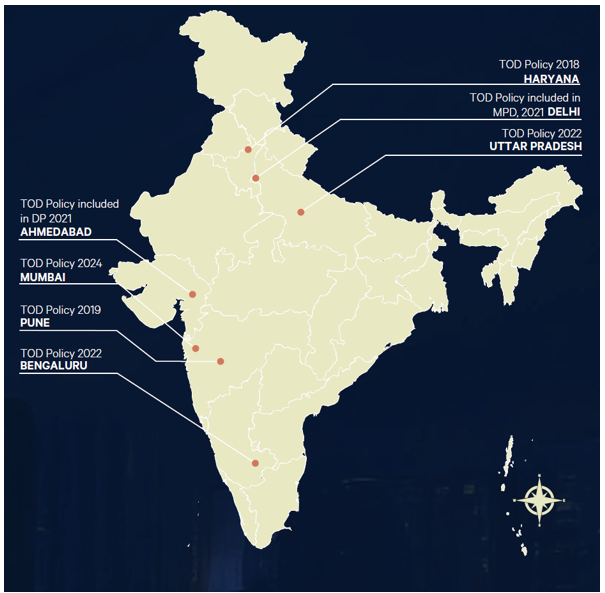
In India, key national policies and guiding documents for TOD include the National Transit Oriented Development Policy and the Smart Cities Mission guidelines, which collectively promote sustainable urban planning and integrated transport systems.
The Way Forward
Global case studies show how TOD links infrastructure with real estate outcomes. Drawing on these, the report recommends best practices for stakeholders that can be adapted to India:
Regulatory interventions
· Create unified urban transport authorities with planning and development powers
· Simplify development control rules in TOD zones
· Enforce parking policies that discourage private vehicle usage
Design-based interventions:
· Implement flexible zoning on plots or demarcate as ‘white sites’ in development plans
· Repurpose existing structures
· Improve the area’s walkability through shaded pathways
Financial interventions:
· Fund transport infrastructure though land-value capture mechanism
· Develop a recurring income stream for maintenance and expansion of transit systems
To gain deeper insights into TOD’s potential and market impact, click on the download button.